Tuesday, October 22, 2013

The Syllabuses 

noun (plural syllabuses or syllabi /-ˌbī/)

  • 1an outline of the subjects in a course of study or teaching:there isn’t time to cover all the syllabuses

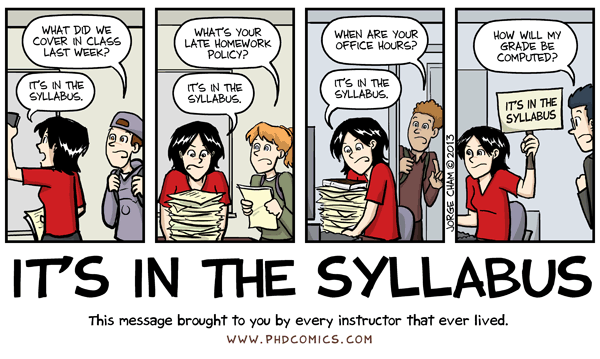
In my new job, I inherited a course syllabus.  I begged for permission to use someone's beefed up syllabus, and several teachers were very helpful and shared theirs with me.  They also gave me permission to use their syllabuses until I could tailor my own. 

I had so many good ideas, to make my syllabus easy and approachable, a real pal to the student, a help and a source of delight and information.  That was until my department explained that there were quite a few policies that needed to get in there, word for word.  The legal department really frowns on paraphrase and summary.

Also my children made fun of my cartoons and comic sans font.  
"Really, Mom?  Do you expect anyone to take you seriously?"
Well, that's an interesting rhetorical question.

I take writing quite seriously, but I often wonder at certain highbrow, lofty academics trying to teach college freshman.   If I am going to do my job correctly, then I may need to be the bridge between critical, academic writing and the ever popular "I Can Has Cheesburger" animal memes.

There is room for both types of writing!
      Not in academic papers, but certainly in the culture.  

The "I Can Has Cheezburger?" site (500,000 hits a day) was created by some Hawaiian guys, and the creative language originated from the 4chan site, an English-language imageboard website launched in 2003. 

4chan - Registration is not required, users post anonymously, and there are many different content boards. Originally a hot spot for discussing manga and anime, 4chan was modeled on Japanese imageboards. However, 4chan has been implicated in hijacking Internet destinations for pranks, provoking media attention.  For media planners they are proof that "creativity is everywhere and new media is less accessible to advertisement agencies," says Gawker, a blog by Manhattanite Nick Denton.

Let the cultures meet!  If Composition I is a prescribed paradigm of academia, a box of MLA and APA guidelines, then....


Saturday, October 12, 2013

My Header Hurts...

It took a whole team of experts to add numbering, a running head and a different first page to my APA style paper this week.

We'd get the header or we'd get the numbering, but each would knock out the other.  My daughter finally Googled it, and the Microsoft experts walked us through the process....

We needed to pick the 3 column header, and then in the number column we had to insert a page.   Wow.   Who knew?    What a fun family activity!

Speaking of fun, my literature review involved examining the process of using technology to teach creativity.  Can you teach an old dog new tricks?
Of course you can.  When you 

  • tease out the thinking skills set and 
  • apply them to new situations, including new technology and software, plus, 
  • create an atmosphere of collaboration and approval, anything is possible!


Monday, October 7, 2013

Creating a Turn It In Account 

http://turnitin.com/

I've had turnitin check my own papers, but today I set up a teacher's account and added three classes, plus their assignments.  The process was fairly easy with prompts took me about an hour, after I laboriously procured the correct account ID and password from my department.  My only confusion came with adding a posting date, immediately after the initiation of the assignment.  I wanted to be able to post about papers that came in early, so I did not make my posting date the same as my due date for each assignment.


Saturday, October 5, 2013

Splashing About In Power Point

October 4, 2013   
     Welcome to my first Power Point presentation, introducing you to the viewpoint of Henry James, featuring his story, Daisy Miller.   https://docs.google.com/file/d/0ByQDL2EBxe8-SmNZbG5DcG1zZHc/edit?usp=sharing

Finding the art, creating each slide and citing the source was a thing of joy and ease.  Why have I been so long avoiding the dreaded event?  I think we can blame all the text heavy, visually stultifying Power Points that have graced many a classroom.  I found that experimenting was easy and the longest part of the process was writing the script or text.  Then, with a portfolio of selected art images, I began to match and present - like scrap booking, but neater.

My artistic choices are simply illustrations, visualizations to illu'stro, enlighten or aid in the introduction of a concept (lenses of alternate perceptions filter and create bias) applied to Henry James’ Daisy Miller.

In a classroom learning setting, I would not explain my choices, but rather, hope to engage my students’ curiosity and set the stage for a collaborative exercise in critical thinking, synthesizing links between their own experiences and the material presented, both textual and artistic.  Peer teams would summarize and predict outcomes from the quotes and settings. This student-centered activity would effectively focus on the cultural context of Henry James’ characters’ dialogue.
However, I am delighted to share my artistic choices with all of you. 
First, all the Impressionist art, with the notable exception of Bacon, was produced during James’ lifetime, and he would most probably have seen it. 
Second, I included the artists that he names specifically in his article “New England: An Autumn Impression.”
Third, I chose artistic renditions of women from a certain high strata of society, indicated by their dress and setting.  That knocks out Manet’s Un bar aux Folies Bergèr, (terribly interesting with it’s optical tricks and interpretations), which might not truly represent Daisy Miller’s intimate society. Portraying the correct time period, this painting’s rich details provide clues to social class and milieu. The woman at the bar was a real person, Suzon, who worked at the Folies-Bergère, a nightclub, whom Manet identifies as a prostitute, according to art historian Larry L. Ligo.  Apparently Manet habitually associated oranges with prostitution in his paintings.  Navel orange, anyone? Edouard Manet, Un bar aux Folies Bergère, 1882
Renoir’s art worked well because during the Paris Commune in 1871 he painted on the banks of the Seine River, when James was critiquing the art scene for the NY Times.  Renoir experienced his initial acclaim when six of his paintings were hung in the first Impressionist exhibition in 1874 (you know, the one James hated).
Aline Victorine Charigot, an object of affection, and painted with that affection's singular interest made obvious, along with a number of the artist's friends, served as a model for Le Déjeuner des canotiers (Luncheon of the Boating Party, 1881), a candid focus on the recreation of an economically -comfortable class in their everyday life.  She, like Daisy, seems full of sparkling color, light, open attitude and good nature.